DeepLabCut: Rat Behavior Analysis
Deep learning pipeline using DeepLabCut to track rat body parts and detect rearing behavior from video data, achieving high accuracy after 350,000+ training iterations.

Training Progress
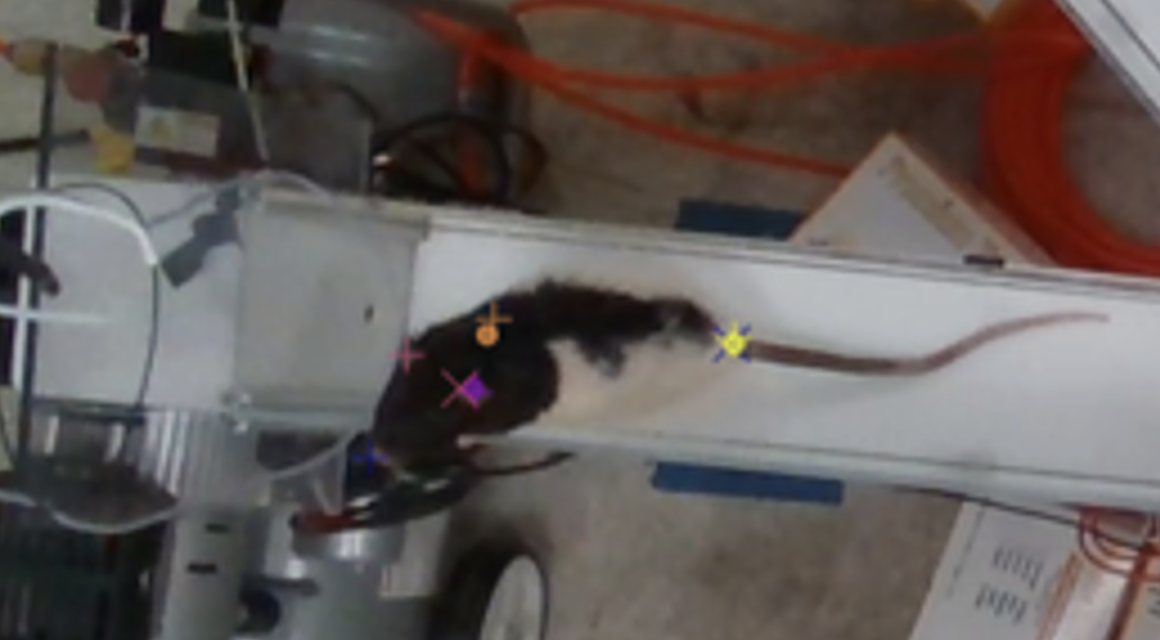
Watch how the model improves from 25,000 to 350,000 training iterations. The pose estimation becomes dramatically more accurate with additional training.
Pipeline overview
Architecture diagram
Overview
A comprehensive deep learning pipeline for analyzing rat rearing behavior using DeepLabCut pose estimation. The project trains a ResNet-50 neural network to track five body parts (nosetip, ears, top back, tail base) and uses spatial relationships between these points to automatically detect rearing events. The model dramatically improves accuracy from 25,000 to 350,000 training iterations, demonstrating the importance of extensive training for pose estimation tasks.
Technologies
Key Features
- ✓Custom pose estimation model training with 350,000+ iterations
- ✓Automated body part tracking (nosetip, ears, back, tail)
- ✓Rearing behavior detection algorithm based on spatial relationships
- ✓Interactive threshold calibration using staircase method
- ✓Labeled video output with tracked body part overlays
- ✓CSV export of frame-by-frame behavior classification
Challenges
Training deep neural networks for accurate pose estimation required extensive GPU compute time and careful hyperparameter tuning. Developing a robust rearing detection algorithm that works across different lighting conditions and camera angles was particularly challenging.
Results
Trained a ResNet-50 pose estimation model across 350,000 iterations to track 5 body parts (nosetip, two ears, top back, tail base) with high spatial accuracy. The trained pipeline automatically labels hours of video and exports per-frame rearing classifications to CSV, replacing manual annotation work that previously took days per session.
© 2026 Maxwell Vaglica. All rights reserved.